




The strong bond between children and comfort objects
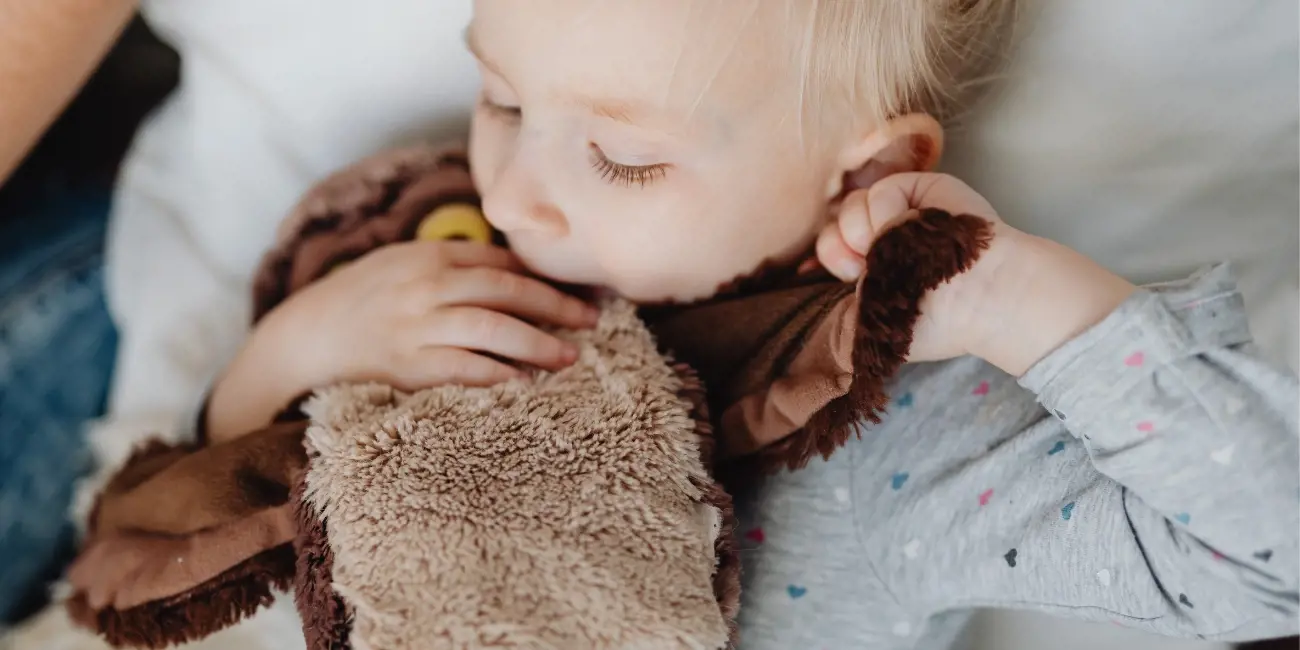
Whether they're cosying up to a velvety blankie or cuddling a flea-bitten dog toy, comfort objects are a positive addition to little people's lives. They have a special way of supporting babies and children as they rest, play, and grow; and over time, these well-loved items become part of the family.
We look at the child-comforter relationship, with some insights from paediatric and child psychology experts.
What are comfort objects?
As the name suggests, comfort objects are items that provide comfort to infants and children to help them feel calm and secure. They're usually snuggled at bedtime but can soothe youngsters through the day as well.
These objects are also known as 'loveys' (because youngsters form a close connection with them) or 'transitional objects' (because they help children transition from being dependent babies to independent older children).
Although different children find comfort in different objects, loveys are usually soft, cuddly, and nice to touch. Some common types are:
- Soft toys such as a teddy or plushie
- Blankets like a fluffy blankie or Kippins baby comforter
- Part of a parent's clothing, for instance, a silky tie or dressing gown trim
Why do children become so attached to comfort objects?
Many children have comfort objects, and there are several reasons why a threadbare teddy or Mum's satin handkerchief is so important to its owner. According to the American Academy of Pediatrics, 'Security objects … are part of the emotional support system every child needs in [their] early years.'
Paediatrician and psychoanalyst, Donald Winnicott, says that comfort objects are a reminder of love and security.
Australia's celebrated children's health expert, Professor Frank Oberklaid, explains that a child's love for their comfort object is a side effect of their wider developmental needs. In other words, transition objects provide the predictability that youngsters require as they separate from their parents (e.g. at bedtime) and gain independence.
Although two comfort objects might look alike, the child's preferred item has a special emotional pull. According to a psychological study by British professor, Bruce Hood, and American professor, Paul Bloom, children become attached to their particular toy or blankie because of an intuitive belief that it has a unique essence or life force.
Professor Hood says that even though children, 'Know these objects are not alive … they believe in them as if they are,' and when given the option of an identical-looking object, the majority of children prefer to keep their original item. It's familiar to them, it smells like them and it has that unique essence no look-alike can mimic.
Search childcare near you.
What are the benefits of comfort objects?
Overall, transitional objects make children feel good and help them manage new experiences. Comfort objects:
- Help children relax and get to sleep
- Are companions that children can talk to, sleep alongside, and share experiences
- Provide reassurance when children are separated from their parents, e.g. at bedtime or childcare
- Provide comfort when children are frightened or upset
- Help children feel secure in unfamiliar environments by providing a link between a new situation and the comfort of home
Many, but not all, children have comfort objects. Research shows attachment is common in Western countries, with rates reaching as high as 60 percent. The pattern is strongly shaped by culture and childrearing practices. Cross-cultural research by Hong and Townes found attachment was considerably more common among American children than Korean children, and an Italian study by Gaddini found it was more common among urban children than those raised in rural areas. Where children spend most of the day and night in close physical contact with a parent, attachment to an object is far less common.
When should children give up their comfort toys?
Although a parent might feel that it's time for their child to let the lovey go, there's no 'normal' age for a child to move on from their comfort toy.
Professor Oberklaid says children grow out of the habit at different times and, 'The age they stop using [comfort] objects varies according to the child, the family situation, the child's temperament [and] experience.'
He adds, 'We see eight-year-olds still with a bunny they had when they were twelve-months-old, and other children for whom the choice of an object has changed over time. What I try to do is normalise all of that behaviour, instead of setting ages where comfort toys are seen as 'abnormal'.
Saying that, if an older child is 'too attached' to their comfort object, parents should consider whether the child is anxious about something else in their lives.
Although one study found that children with strong bonds to comfort objects have stronger attachments to a parent and are happier than those without a lovey, the same study found that teenagers who need their comfort objects daily may have poorer mental health.
Should children take comfort toys to childcare?
Interestingly, childcare itself appears linked to comfort-object attachment. A large twin study found that children who attended full-day childcare were significantly more likely to form an attachment to a comfort object than children in half-day care. That fits what educators see day to day, since a lovey gives a child a familiar anchor during a longer stretch away from home.
Again, this comes down to the temperament of the child. Professor Oberklaid says that 'Parents need to make that decision based on their instinct. For some kids, the thought of separation from something at any time is so traumatic that by all means let them take it. For others, you can reason with them and tell them Teddy will be in their room when they get home.'
If the child does take their lovey to care, then it's fair enough to treat this item differently. Although sharing is an important social skill to practice, it's ok if the child doesn't want to hand their transitional toy to anyone else. It's completely understandable.
Get childcare and parenting news straight to your inbox


Comfort objects and starting childcare
The bottom line for most families is reassuring. A comfort object isn't a problem to be managed or a habit to be broken on a schedule. For the majority of children it's a normal, healthy tool that helps them feel secure, manage change, and grow more independent in their own time. The threadbare teddy is doing a real job.
If that job includes settling into childcare, the right environment makes a noticeable difference to how smoothly a child separates and how quickly they feel at home. Care for Kids lists childcare services across Australia, so you can find services near you, compare them, and talk to them directly about how they help children settle in, including whether little ones can bring a familiar comfort object along for those first weeks.
FAQs
Is it normal for my child to be attached to a comfort object?
Yes, it's very common and considered part of healthy development. Research shows up to 60 percent of children in Western countries form strong attachments to a comfort object such as a soft toy or blanket. Paediatricians describe these "loveys" as part of the emotional support system children draw on in their early years.
What age should a child give up a comfort toy?
There's no "normal" age to let a comfort object go. Australian children's health expert Professor Frank Oberklaid notes that children move on at different times depending on their temperament, family situation and experiences, and that some children keep an object well into the primary years. The healthiest approach is to treat a wide range of timing as normal rather than setting an age where the object is seen as a problem.
Can my child be too attached to a comfort object?
For most young children, a strong attachment is reassuring rather than a concern, and research links it to secure parental attachment and greater happiness. If an older child seems unusually reliant on their object, it's worth gently considering whether they're anxious about something else going on in their life, rather than focusing on the object itself.
Should my child take a comfort object to childcare?
A comfort object can genuinely help, because it provides a link between the unfamiliar childcare environment and the security of home, and eases separation at drop-off. Check your service's policy first, since some have guidelines about which items can come along and where they're kept during the day.
What's the difference between a comfort object and a transitional object?
They're two names for the same thing. "Comfort object" describes what it does, soothing and reassuring a child, while "transitional object" describes its developmental role, helping a child move from depending on a parent toward greater independence. You may also see them called “loveys.”


Comments (0)